Architecture Overview
This document describes the internal architecture of the openlifu Python
library, a toolbox for planning and controlling focused ultrasound treatments.
It covers the module structure, core data flow, class hierarchies, and
integration points between subsystems.
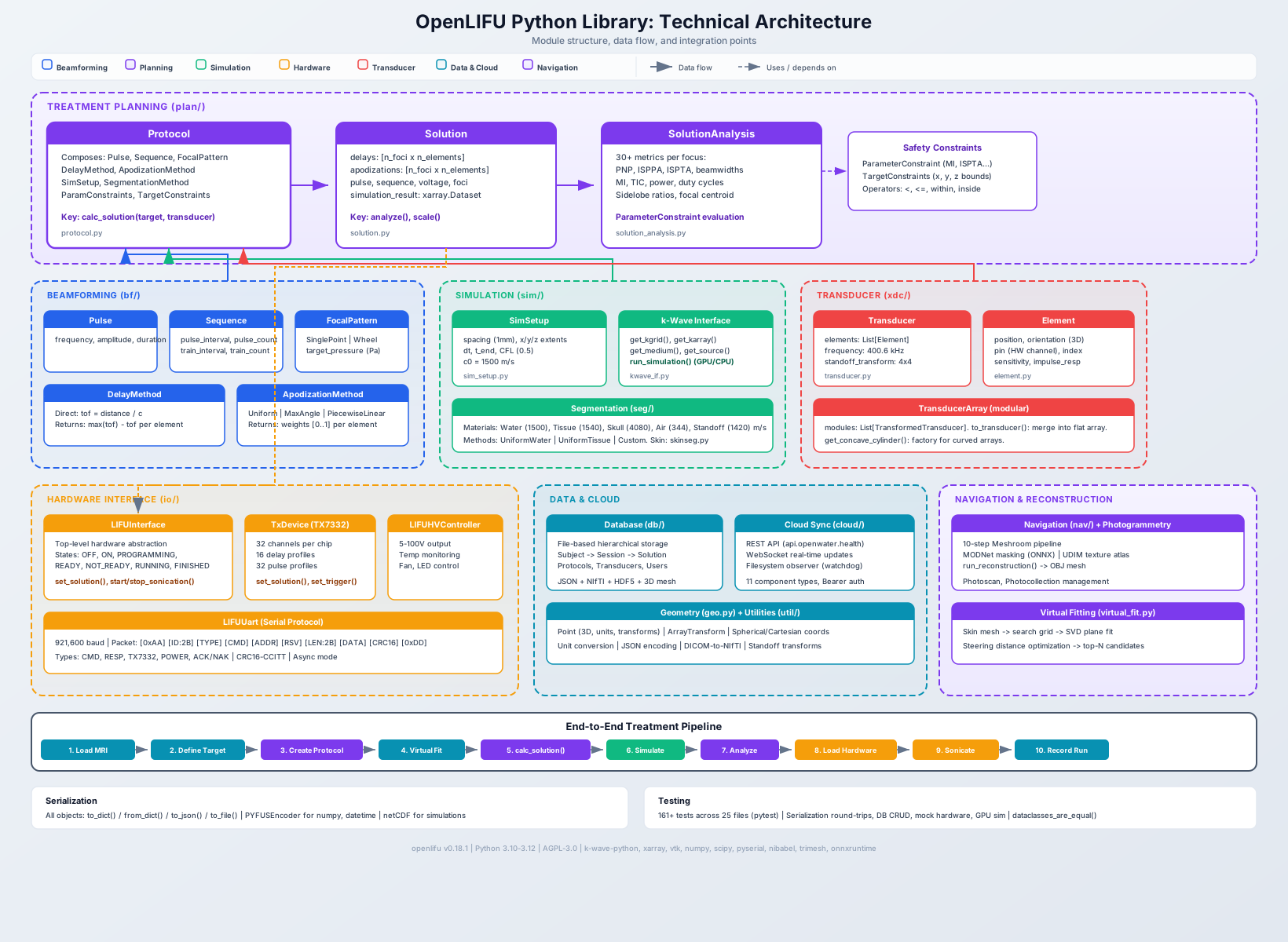
High-level architecture diagram of the OpenLIFU library, showing module structure, data flow between components, and the end-to-end treatment planning pipeline.
Module Map
The library is organized into 10 top-level modules under src/openlifu/:
openlifu/
├── bf/          Beamforming (pulses, sequences, delays, apodization, focal patterns)
├── plan/        Treatment planning (protocols, solutions, analysis, constraints)
├── xdc/         Transducer geometry (elements, arrays, transformations)
├── sim/         Acoustic simulation (k-Wave integration, grid setup)
├── seg/         Tissue segmentation (materials, segmentation methods)
├── io/          Hardware interface (TX7332 driver, HV controller, UART)
├── db/          Database (file-based persistence for subjects, sessions, protocols)
├── nav/         Navigation (photogrammetry, Meshroom reconstruction, masking)
├── cloud/       Cloud sync (REST API, WebSocket, filesystem observer)
├── util/        Utilities (units, JSON encoding, volume conversion, strings)
├── geo.py       Geometry primitives (Point, ArrayTransform, coordinate math)
└── virtual_fit.py  Transducer placement optimization
The library is organized into 70+ Python files.
End-to-End Treatment Workflow
The library supports a complete treatment pipeline from patient imaging through hardware execution:
1. Load Patient MRI        (db, util/volume_conversion)
2. Define Target            (geo.Point)
3. Create Protocol          (plan.Protocol with bf, sim, seg components)
4. Virtual Fit Transducer   (virtual_fit + seg/skinseg)
5. Compute Solution         (plan.Protocol.calc_solution)
   a. Beamform              (bf.DelayMethod + bf.ApodizationMethod)
   b. Simulate              (sim.run_simulation via k-Wave)
   c. Analyze               (plan.SolutionAnalysis)
   d. Scale                 (plan.Solution.scale)
6. Load to Hardware         (io.LIFUInterface.set_solution)
7. Execute Sonication       (io.LIFUInterface.start_sonication)
8. Record Run               (plan.Run, db.Database)
Each step maps to one or more modules. The Protocol class in
plan/protocol.py serves as the central orchestrator, composing
beamforming, simulation, and segmentation components through its
calc_solution() method.
Beamforming Module (bf/)
The beamforming module defines the acoustic parameters of a treatment: what pulses to send, in what sequence, where to focus, and how to calculate per-element delays and weights.
Pulse and Sequence
Pulse defines a sinusoidal burst:
frequency(Hz),amplitude(0-1),duration(seconds)calc_pulse(t)returnsamplitude * sin(2*pi*frequency*t)
Sequence defines pulse timing:
pulse_interval,pulse_count(within a train)pulse_train_interval,pulse_train_count(between trains)Validates that
pulse_train_interval >= pulse_interval * pulse_count
Focal Patterns
Abstract base class FocalPattern with two concrete implementations:
SinglePoint: Returns[target.copy()]. One focus.Wheel: Returns center point (optional) plusnum_spokespoints arranged in a circle ofspoke_radiusaround the target. Usestarget.get_matrix(center_on_point=True)to compute spoke positions in the target’s local coordinate frame.
The FocalPattern.target_pressure field (in Pa) is used during solution
scaling to adjust apodization and voltage until the simulated peak pressure
matches the target.
Delay Methods
Abstract base class DelayMethod with one concrete implementation:
Direct: Time-of-flight calculation. For each element, computesdistance_to_target / speed_of_sound. Returnsmax(tof) - tofso the furthest element has zero delay and all others are advanced. Speed of sound is taken fromparams['sound_speed'].attrs['ref_value']or falls back toself.c0(default 1480 m/s).
Apodization Methods
Abstract base class ApodizationMethod with three implementations:
Uniform: All elements weighted equally (np.full(n, value)).MaxAngle: Binary cutoff. Elements with angle to target exceedingmax_angleare set to 0; others to 1.PiecewiseLinear: Linear rolloff betweenrolloff_angle(weight=1) andzero_angle(weight=0).
MaxAngle and PiecewiseLinear use element.angle_to_point()
to compute the angle between each element’s normal vector and the direction
to the target. Uniform ignores element geometry entirely.
Treatment Planning Module (plan/)
The planning module orchestrates beamforming, simulation, and analysis into a complete treatment solution.
Protocol
Protocol is the central configuration object. It composes:
A
PulseandSequence(what to send)A
FocalPattern(where to focus)A
DelayMethodandApodizationMethod(how to beamform)A
SimSetup(simulation grid parameters)A
SegmentationMethod(tissue property mapping)ParameterConstraintandTargetConstraints(safety limits)SolutionAnalysisOptionsandVirtualFitOptions
The key method is calc_solution():
Protocol.calc_solution(target, transducer, volume, ...)
  |
  +-> check_target(target)              # Validate target is in bounds
  +-> sim_setup.setup_sim_scene(...)     # Create acoustic parameter grid
  +-> focal_pattern.get_targets(target)  # Get list of foci
  |
  +-> FOR EACH focus:
  |     +-> beamform(transducer, focus, params)
  |     |     +-> delay_method.calc_delays(...)   -> delays [n_elements]
  |     |     +-> apod_method.calc_apodization(...) -> apod [n_elements]
  |     +-> run_simulation(...)                   -> xa.Dataset
  |
  +-> Stack results: delays [n_foci x n_elements]
  +-> Create Solution object
  +-> Optionally scale to target_pressure
  +-> Optionally analyze (beamwidth, MI, TIC, intensities)
  +-> Return (Solution, simulation_result, SolutionAnalysis)
Solution
Solution stores the computed sonication plan:
delays: shape(num_foci, num_elements)in secondsapodizations: shape(num_foci, num_elements)in [0, 1]pulse,sequence,voltage: execution parametersfoci: list ofPointobjects (actual focal positions)target: the original targetPointsimulation_result:xarray.Datasetwith pressure fieldsapproved: boolean safety flag
The analyze() method computes 30+ metrics per focus including peak
pressures, beamwidths at -3 dB and -6 dB, sidelobe ratios, mechanical
index, thermal index, and duty cycles. Results are returned as a
SolutionAnalysis dataclass.
The scale() method adjusts apodizations and voltage so that simulated
peak pressure matches FocalPattern.target_pressure.
Solution Analysis
SolutionAnalysis contains per-focus lists of metrics and
global aggregate values. Key fields:
mainlobe_pnp_MPa,mainlobe_isppa_Wcm2,mainlobe_ispta_mWcm2beamwidth_lat_3dB_mm,beamwidth_ele_3dB_mm,beamwidth_ax_3dB_mmsidelobe_to_mainlobe_pressure_ratioMI(mechanical index),TIC(thermal index cranial)voltage_V,power_W,duty_cycle_sequence_pct
Each metric can be evaluated against ParameterConstraint objects that
define warning and error thresholds with configurable operators
(<, <=, >, >=, within, inside, outside).
Transducer Module (xdc/)
Models the physical geometry of ultrasound transducer arrays.
Element
Element represents a single rectangular transducer element:
position(3D),orientation(3-vector:[az, el, roll]around[y, x', z'']axes, in radians),size(width x length)pin(hardware channel mapping),index(logical index)sensitivity(Pa/V),impulse_response(FIR filter)
Key methods: distance_to_point(), angle_to_point(),
get_matrix() (4x4 affine from position and orientation),
calc_output() (apply impulse response and sensitivity).
Transducer
Transducer is a collection of Element objects:
elements: list of Element instancesfrequency: nominal frequency (default 400.6 kHz)standoff_transform: 4x4 affine for acoustic coupling layermodule_invert: per-module polarity flags
Key methods: get_positions(), calc_output() (with delays and
apodization), gen_matrix_array() (factory for rectangular arrays),
merge() (combine multiple transducers).
TransducerArray
TransducerArray holds multiple TransformedTransducer
modules with lazy transform application. to_transducer() merges all
modules into a single flat Transducer. get_concave_cylinder() is
a factory for creating cylindrically curved arrays with a specified
radius of curvature.
Simulation Module (sim/)
Integrates with the k-Wave acoustic simulation library for full-wave pressure field computation.
SimSetup
SimSetup configures the simulation domain:
spacing(default 1.0 mm),units(default “mm”)x_extent,y_extent,z_extent(domain bounds)dt,t_end(time step and duration; 0 = auto from CFL)c0(reference sound speed, 1500 m/s),cfl(0.5)
Extents are automatically rounded to exact multiples of spacing during
initialization. setup_sim_scene() creates the acoustic parameter
grid by applying a segmentation method to a volume (or filling with
reference material properties if no volume is provided).
k-Wave Interface
kwave_if.py wraps the k-wave-python library:
get_kgrid(): Creates simulation grid from coordinatesget_karray(): Builds k-Wave source array from Transducer elementsget_medium(): Maps segmented tissue properties to k-Wave formatget_sensor(): Full-domain pressure sensorget_source(): Distributes beamformed signal across arrayrun_simulation(): ExecuteskspaceFirstOrder3D, returnsxarray.Datasetwithp_max,p_min, andintensityfields
Intensity is computed as I = 10^-4 * p_min^2 / (2 * Z) where
Z = density * sound_speed is the acoustic impedance.
Segmentation Module (seg/)
Maps tissue types to acoustic material properties for simulation.
Materials
Five predefined materials with full acoustic parameter sets:
Material |
Sound Speed |
Density |
Attenuation |
|---|---|---|---|
Water |
1500 m/s |
1000 kg/m3 |
0.0 dB/cm/MHz |
Tissue |
1540 m/s |
1000 kg/m3 |
0.0 dB/cm/MHz |
Skull |
4080 m/s |
1900 kg/m3 |
0.0 dB/cm/MHz |
Air |
344 m/s |
1.25 kg/m3 |
0.0 dB/cm/MHz |
Standoff |
1420 m/s |
1000 kg/m3 |
1.0 dB/cm/MHz |
Each material also carries specific_heat and thermal_conductivity
for thermal modeling.
Segmentation Methods
Abstract base SegmentationMethod provides:
seg_params(volume): Segment volume and return acoustic parameter datasetref_params(coords): Return uniform reference material parameters_map_params(seg): Convert integer segmentation labels to material arrays
Concrete implementations: UniformWater, UniformTissue (both fill
entire domain with a single material).
Skin Segmentation
skinseg.py extracts the skin surface from MRI for
virtual fitting:
compute_foreground_mask(): Otsu thresholding with morphological closing and hole filling (ported from BRAINSTools)create_closed_surface_from_labelmap(): VTK flying edges surface extraction with optional decimation and smoothingspherical_interpolator_from_mesh(): Creates a callable that maps spherical coordinates (theta, phi) to radial distance from origin, enabling fast surface queries during virtual fitting
Hardware Interface Module (io/)
Communicates with the physical LIFU transducer hardware over serial UART.
UART Protocol
LIFUUart implements packet-based serial communication at
921,600 baud with CRC16-CCITT checksums.
Packet format:
[0xAA] [ID:2B] [TYPE:1B] [CMD:1B] [ADDR:1B] [RSV:1B] [LEN:2B] [DATA:*] [CRC:2B] [0xDD]
Packet types include OW_CMD (command), OW_RESP (response),
OW_TX7332 (chip control), OW_POWER (HV management), and
OW_ACK/OW_NAK (acknowledgment).
TX7332 Device Driver
LIFUTXDevice controls TI TX7332 ultrasound beamformer ICs.
Each chip drives 32 channels. A typical system has 2-4 chips for 64-128
elements.
The register architecture has three regions:
Global registers (0x00-0x1F): Mode, standby, power, trigger, pattern selection, apodization
Delay data (0x20-0x11F): 16 delay profiles, each mapping 32 channels to 13-bit delay values
Pattern data (0x120-0x19F): 32 pulse profiles with per-period level and length encoding
The set_solution() method translates a Solution object into register
writes:
Creates
Tx7332PulseProfilefrom pulse frequency and durationCreates
Tx7332DelayProfilefrom delay and apodization arraysDistributes across TX7332 chips (32 channels per chip)
Writes all registers via
apply_all_registers()
HV Controller
LIFUHVController manages the high-voltage power supply:
Voltage control (5-100V range)
Enable/disable HV and 12V outputs
Temperature monitoring (two sensors, Celsius)
Fan and RGB LED control
Firmware version and hardware ID queries
LIFUInterface
LIFUInterface is the top-level hardware abstraction:
LIFUInterface
├── TxDevice (TX7332 driver)
│   ├── LIFUUart (serial port)
│   └── TxDeviceRegisters
│       └── Tx7332Registers[n_chips]
└── HVController (power supply)
    └── LIFUUart (serial port)
States: SYS_OFF -> POWERUP -> SYS_ON -> PROGRAMMING ->
READY -> RUNNING -> FINISHED. Additional states include
STATUS_NOT_READY, STATUS_COMMS_ERROR, and STATUS_ERROR for
fault handling.
Safety is enforced through voltage lookup tables indexed by duty cycle
and sequence duration. The check_solution() method validates that
a solution’s parameters fall within hardware limits before programming.
Database Module (db/)
File-based hierarchical persistence for all treatment data.
Storage Layout
database_root/
├── subjects/
│   └── {subject_id}/
│       ├── volumes/
│       └── sessions/
│           └── {session_id}/
│               ├── runs/
│               │   └── {run_id}/
│               ├── solutions/
│               │   └── {solution_id}/
│               ├── photoscans/
│               │   └── {photoscan_id}/
│               └── photocollections/
├── protocols/
├── transducers/
├── systems/
└── users/
Each entity is stored as a JSON file with its ID as the filename.
Index files (subjects.json, protocols.json, etc.) track all IDs
at each level. Volumes store NIfTI data alongside JSON metadata.
Transducers may include HDF5 grid weight caches and 3D mesh files.
All write operations accept an OnConflictOpts enum (ERROR,
OVERWRITE, SKIP) for conflict resolution.
Data Models
Subject: id, name, attrsSession: id, subject_id, protocol_id, volume_id, transducer_id, targets (list of Point), markers, virtual_fit_results, transducer_tracking_resultsUser: id, password_hash, roles, name, descriptionRun: id, session_id, solution_id, success_flag, note
Virtual Fitting (virtual_fit.py)
Optimizes transducer placement on the patient’s head to reach a target.
Algorithm
Extract skin surface from MRI via
compute_foreground_mask()andcreate_closed_surface_from_labelmap()Build spherical interpolator from skin mesh
Generate search grid in pitch/yaw (azimuthal/polar) coordinates
For each candidate position:
Query skin surface distance at (theta, phi)
Fit local plane to nearby surface points via SVD
Construct transducer coordinate frame from plane normal
Compose with standoff transform
Compute steering distance from target to transducer focus
Check against steering limits
Sort candidates by steering distance, return top N
The algorithm operates in ASL (Anterior-Superior-Left) coordinates internally, converting to RAS for output.
Cloud Module (cloud/)
Bidirectional sync between local database and cloud API.
Architecture
Three-layer change detection:
Filesystem observer (
watchdoglibrary) monitors local database for file changesWebSocket (Socket.IO) receives real-time remote change notifications
Sync thread batches changes with 1-second debounce
The Cloud class orchestrates 11 component types (Users, Protocols,
Systems, Transducers, Subjects, Volumes, Sessions, Runs, Solutions,
Photoscans, Databases) through a hierarchical parent-child structure.
REST API endpoints at https://api.openwater.health use Bearer token
authentication. Each component manages its own config files and optional
binary data files (volumes, meshes, textures).
Conflict resolution uses timestamp comparison: if remote mtime is
newer, download from cloud; if local is newer, upload to cloud.
Geometry Primitives (geo.py)
Point
The Point dataclass represents a 3D position with metadata:
position(3-vector),id,name,color(RGB),radiusdims(dimension names),units(spatial units)
get_matrix() constructs a 4x4 affine transform representing a local
coordinate frame at the point, with the z-axis pointing toward the point
from a reference origin.
Coordinate Utilities
cartesian_to_spherical()/spherical_to_cartesian(): scalar and vectorized conversionsspherical_coordinate_basis(theta, phi): returns 3x3 matrix of[r_hat, theta_hat, phi_hat]basis vectorscreate_standoff_transform(z_offset, dzdy): models acoustic gel layer between transducer and skin
Utilities (util/)
units.py: Comprehensive unit conversion supporting SI prefixes, compound units (m/s,dB/cm/MHz), and angle/time typesjson.py: CustomPYFUSEncoderfor numpy arrays, datetime, and domain objectsvolume_conversion.py: DICOM to NIfTI conversion with affine extraction fromImageOrientationPatientandImagePositionPatienttagsstrings.py: ID sanitization with snake_case, camelCase, PascalCase supportdict_conversion.py:DictMixinbase class forto_dict()/from_dict()serializationassets.py: Model download and cache management
Design Patterns
Serialization
All domain objects implement to_dict()/from_dict() for JSON
serialization. The PYFUSEncoder handles numpy arrays, datetime
objects, and nested domain types. Simulation results use netCDF
(xarray.Dataset) for large multidimensional data.
Strategy Pattern
Beamforming uses pluggable strategies throughout:
DelayMethod->Direct(or future ray-traced)ApodizationMethod->Uniform,MaxAngle,PiecewiseLinearFocalPattern->SinglePoint,WheelSegmentationMethod->UniformWater,UniformTissue
Each strategy is a dataclass with to_dict()/from_dict() that
encodes the class name, enabling polymorphic deserialization.
Unit Awareness
Geometric quantities carry explicit units (mm, m, deg, rad).
The getunitconversion() function handles all conversions including
compound units. Most methods accept an optional units parameter for
on-the-fly conversion.
Coordinate Systems
Transducer space: Element-relative (lateral, elevation, axial)
RAS: Right-Anterior-Superior (clinical imaging standard)
LPS: Left-Posterior-Superior (DICOM standard)
ASL: Anterior-Superior-Left (virtual fitting internal)
Transforms between spaces use 4x4 affine matrices throughout.
Dependency Graph
plan.Protocol
  ├── bf.Pulse, bf.Sequence
  ├── bf.FocalPattern (SinglePoint, Wheel)
  ├── bf.DelayMethod (Direct)
  ├── bf.ApodizationMethod (Uniform, MaxAngle, PiecewiseLinear)
  ├── sim.SimSetup
  ├── seg.SegmentationMethod
  ├── plan.ParameterConstraint
  ├── plan.TargetConstraints
  └── plan.SolutionAnalysisOptions

plan.Solution
  ├── bf.Pulse, bf.Sequence
  ├── xdc.Transducer
  ├── geo.Point (foci, target)
  └── xarray.Dataset (simulation_result)

io.LIFUInterface
  ├── io.TxDevice -> io.LIFUUart
  └── io.HVController -> io.LIFUUart

db.Database
  ├── db.Session -> geo.Point, geo.ArrayTransform
  ├── db.Subject
  └── db.User

nav.run_reconstruction
  └── Meshroom (external process)

virtual_fit.run_virtual_fit
  ├── seg.skinseg (skin surface extraction)
  └── geo (spherical coordinates, transforms)
Testing
The test suite contains 161+ tests across 25 files using pytest. Key patterns:
Serialization round-trip tests (JSON, dict, file for all domain objects)
Database CRUD with
OnConflictOptstesting (ERROR, OVERWRITE, SKIP)Custom
dataclasses_are_equal()helper for deep comparison including numpy arrays and xarray datasetsMock-based tests for hardware (
LIFUInterface) and GPU availabilityResource files in
tests/resources/with example databases and configsCoverage via
pytest-cov
Configuration is in pyproject.toml with strict markers, warnings-as-errors
(with targeted suppressions for k-Wave and pyparsing), and INFO-level
CLI logging.